

There are moments when data becomes more than a number.
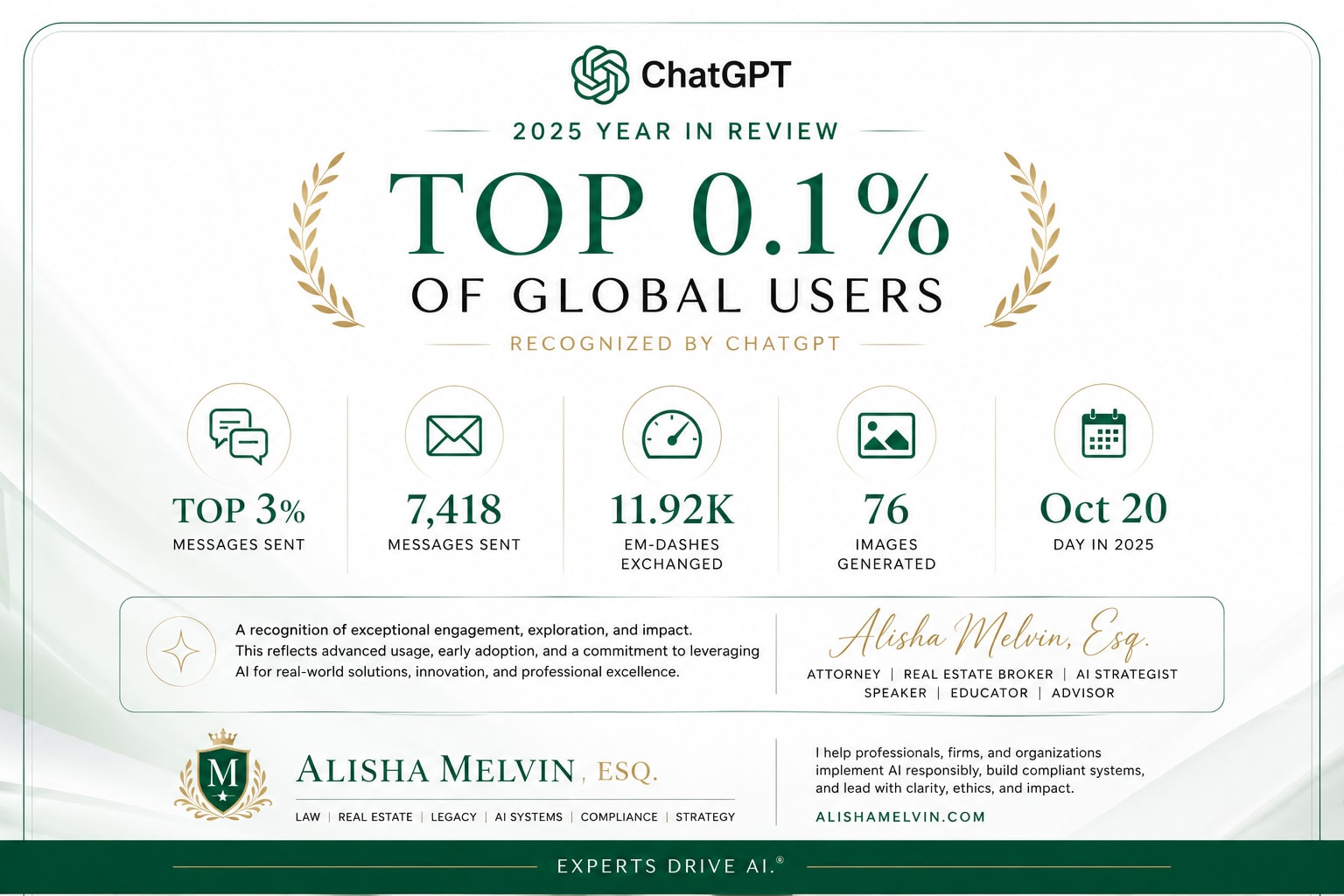
For me, one of those moments came through my personal 2025 ChatGPT Year in Review provided to me by OpenAI inside ChatGPT. According to that year-in-review, I was shown among ChatGPT’s top 0.1% of global users and top 3% for messages sent.
I did not receive that as a vanity metric.
I received it as confirmation of something I already knew from experience: serious AI use is not passive. It is not casual. It is not just asking a tool to write a caption, summarize an article, or generate a cute graphic.
At its highest level, AI use becomes a practice.
It requires judgment, repetition, testing, structure, documentation, correction, creativity, and responsibility.
And after spending this level of time inside AI systems, here is what I know for sure:
AI does not eliminate the need for expertise. It exposes the absence of it.
AI Is Not Magic. It Is Magnification.
AI can make a strong professional faster, more organized, and more strategically equipped.
But it can also make an untrained person confidently wrong at scale.
That is the part we do not talk about enough.
When people discuss AI, the conversation often centers around speed. Faster content. Faster drafts. Faster answers. Faster research. Faster workflows.
But speed without judgment is not innovation. It is risk wearing a nice outfit.
In law, real estate, business, finance, education, and other professional spaces, the issue is not whether AI can produce output. Of course it can.
The better question is:
Who is qualified to evaluate the output?
That is where expertise still matters.
Prompting Is Not the Same as Professional Implementation
There is a difference between using AI and building with AI.
Using AI might mean asking a tool to help with a task.
Building with AI means designing systems, workflows, guardrails, review processes, documentation standards, and risk controls around the use of those tools.
That distinction matters deeply for professionals.
A licensed attorney, broker, CPA, advisor, physician, educator, or executive cannot approach AI the same way a casual user approaches it. The consequences are different. The duties are different. The risks are different.
Professional AI implementation requires more than curiosity.
It requires:
- domain expertise
- ethical awareness
- data discipline
- confidentiality safeguards
- human review
- governance standards
- accountability
That is why my work around AI has continued to center on one principle:
Experts Drive AI.
The Tool Should Never Be Smarter Than the Person Responsible for the Outcome
AI can support the work.
It can accelerate the work.
It can organize, draft, analyze, compare, and brainstorm.
But it should never replace the professional judgment required to decide whether the work is accurate, ethical, compliant, and appropriate for the situation.
That is especially true in regulated or high-trust fields.
A professional using AI must still ask:
Is this accurate?
Is this current?
Is this appropriate for the client, audience, or matter?
Does this involve confidential or sensitive information?
Does this create legal, financial, reputational, or compliance risk?
Does this require human review before use?
AI may be able to generate language.
But it cannot carry your license.
It cannot carry your fiduciary duty.
It cannot carry your ethical obligations.
It cannot carry your reputation.
That part is still on you.
Why the Top 0.1% Metric Matters to Me
The reason I am sharing this recognition is not to say, “Look at me.”
It is to say that my perspective on AI is not theoretical.
It comes from actual use, testing, building, breaking, refining, teaching, and implementing systems across my professional ecosystem.
As an attorney, real estate broker, educator, speaker, and business strategist, I have used AI to study workflows, develop frameworks, improve communication, create training structures, organize complex ideas, and think through the future of professional service delivery.
That experience has shaped my belief that AI adoption must be responsible, strategic, and expert-led.
The most dangerous AI user is not the beginner.
It is the person who believes the tool is always right.
Responsibility Is the New AI Credential
The next wave of AI leadership will not belong to the loudest person online.
It will belong to the people who can combine technical curiosity with professional responsibility.
The people who understand both opportunity and risk.
The people who know when to automate and when to stop.
The people who know when AI is helpful, when it is insufficient, and when human judgment is non-negotiable.
That is the future I am building toward through my AI education, speaking, and AMELIA Blueprint work.
Not AI for hype.
AI for systems.
AI for service.
AI for professional excellence.
AI with governance.
AI with accountability.
AI led by experts.
Final Thought
Being shown among ChatGPT’s top 0.1% of users did not make me an AI expert by itself.
The number is not the authority.
The work behind the number is.
The learning.
The testing.
The implementation.
The governance.
The professional judgment.
The willingness to keep asking better questions.
That is what this season has taught me.
AI is powerful.
But power without wisdom is dangerous.
And that is why I will continue saying it:
Experts Drive AI.